
Twenty-four years is a short time for a nation to find its footing. Yet for Timor-Leste, those two decades-plus span a journey from the rubble of occupation, through the euphoria of independence, to today — standing at the threshold of its most consequential chapter yet: full integration as the 11th member of ASEAN.
That membership is not merely symbolic recognition. It represents a structural shift that compels Dili to redefine its foreign policy doctrine from the ground up. The question that now presses is no longer whether Timor-Leste belongs at the ASEAN table — that has been answered. The question that matters is: with what capital, and through what strategy, will Timor-Leste sit at that table with dignity?
In Seoul, part of that answer is being written.
Seoul: A Choice That Is No Accident
In the new diplomatic geometry of post-ASEAN Timor-Leste, the choice of South Korea as the principal node of engagement in East Asia carries layered logic. This is not about geographic proximity — Seoul and Dili are separated by thousands of kilometres. This is about historical precedent and the relevance of a model.
South Korea stands as the only nation in Asia to have achieved a full transformation from a post-war agrarian economy to a global industrial powerhouse in fewer than four decades. The Miracle on the Han River is not mythology. It is the product of a proven combination: massive educational investment, planned industrialisation, aggressive technology transfer, and development-oriented state leadership sustained over the long term. That is precisely the combination Timor-Leste is seeking.
Ambassador of Timor-Leste to the Republic of Korea, H.E. António de Sá Benevides, understands this as more than rhetoric. In his vision, the Seoul-Dili relationship must be shifted fundamentally: from a hierarchical donor-recipient dynamic toward an equal and mutually beneficial strategic partnership. This paradigm shift is no small matter — it touches the diplomatic self-respect of a young nation still building its global identity.
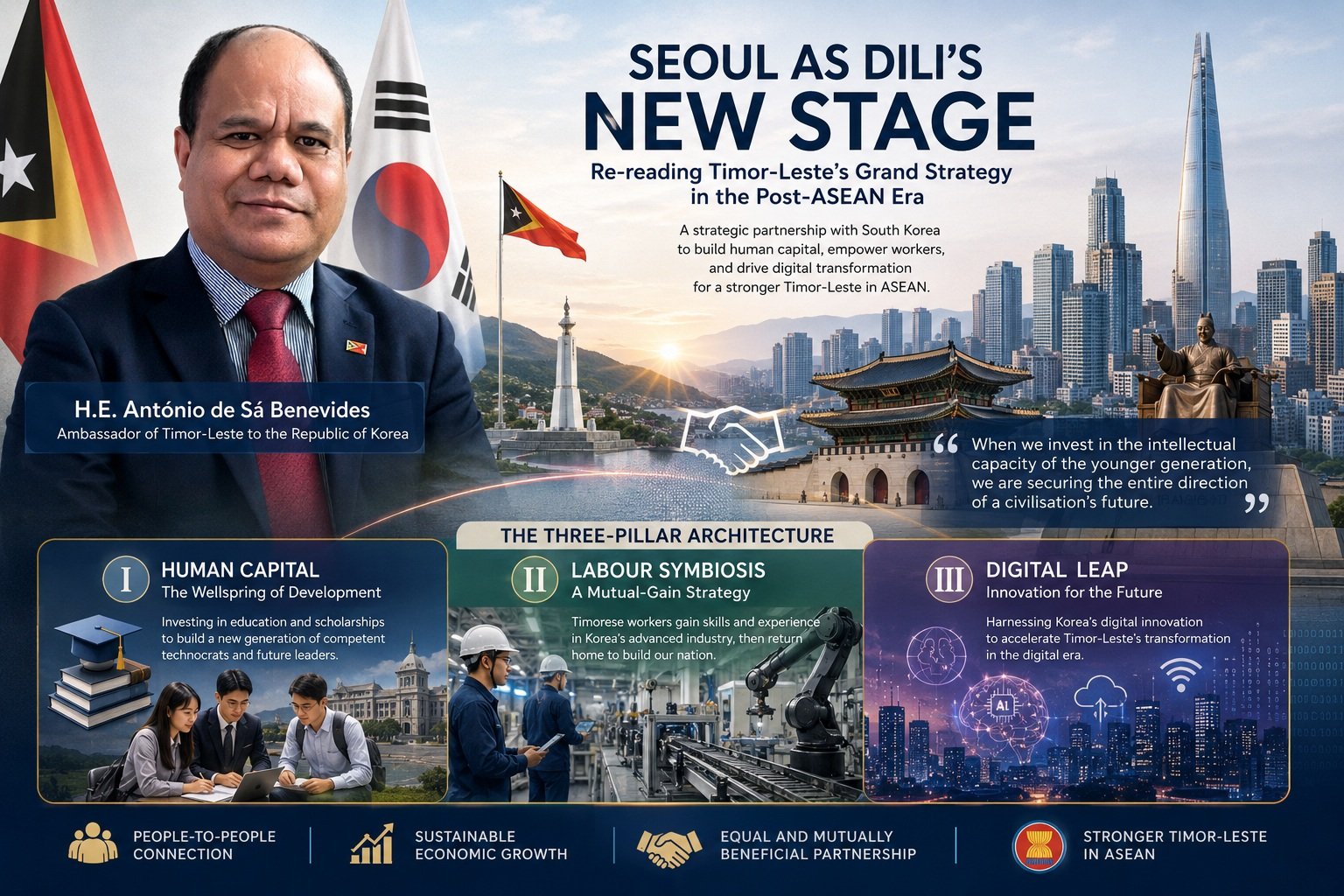
The Three-Pillar Architecture: Reading the Benevides Blueprint
Ambassador Benevides' approach in Seoul rests on three strategic axes, each reinforcing the others. They do not stand alone; they are designed as a coherent ecosystem.
Pillar One
Human Capital as the Wellspring of Development
For a nation with a demographic structure as young as Timor-Leste's — where more than half the population is under 25 — investment in human capacity is not a policy option; it is an existential imperative. Without a generation of competent, globally minded technocrats, Timor-Leste risks showing up at ASEAN forums as a listener, not a shaper of direction.
South Korea, with its highly competitive higher-education ecosystem and strong research traditions, is the natural partner. The Embassy in Seoul is now actively negotiating expanded scholarship quotas, promoting direct university-to-university partnerships, and streamlining administrative procedures for Timorese students.
More important than the scholarship numbers is the philosophy behind them. The true aim is not simply to produce holders of foreign degrees, but to shape a new class of technocrats who carry Korea's developmental worldview — pragmatic, results-oriented, grounded in science and technology. In an exclusive, in-depth interview with journalist Jason Bouis — recorded as part of the Special Coverage Series (Part 3) in Seoul — Ambassador Benevides made this mission explicit:
"When Timor-Leste's young intellectuals return from Korea, they bring more than academic degrees. They bring a new worldview, advanced technical skills, and competencies of immeasurable worth. Because at its core, when we invest energy in the intellectual capacity of the younger generation, we are securing the entire direction of a civilisation's future."
It is this generation that will eventually occupy the key positions in Timor-Leste's bureaucracy, corporations, and research institutions — the cadre that will translate diplomatic ambition into economic substance at ASEAN's negotiating tables.
Pillar Two
Labour Symbiosis: A Mutual-Gain Strategy
Here lies the most concrete strategic intelligence of the Benevides framework. Timor-Leste and South Korea share a demographic gap that is complementary by nature: Timor-Leste has a surplus of young, motivated, and capable workers who remain underabsorbed by the domestic economy; South Korea faces a significant labour shortage in its manufacturing sector as a consequence of sharp population ageing.
Anticipating public scepticism about a labour-export programme, Ambassador Benevides clarified the direction of his policy candidly in that same exclusive interview with Jason Bouis:
"Our workers do not only come to work — they come to learn within South Korea's modern industrial manufacturing ecosystem. They absorb the ethos of precision workmanship, and they return home carrying solid technical skills to build the domestic industrial structure of Timor-Leste."
This labour-placement programme is therefore not a short-term employment solution. It is a planned competency-transfer incubator. Workers exposed to Korean industrial standards — process discipline, an innovation culture, modern work methodology — bring home more than remittance savings. They carry technical capital that, if well-managed, can lay the foundations for Timor-Leste's domestic industrialisation.
The success of this pillar, however, depends critically on whether structured reintegration mechanisms exist. Without a clear re-employment pathway for returning workers, the skills they acquire risk being misallocated or underutilised in the context of national development.
Pillar Three
Digital Leapfrogging: A Shortcut Through History
The third pillar is the most visionary — and the most fraught with risk. Timor-Leste does not have the luxury of ascending the industrialisation ladder in linear fashion: building textile factories first, then electronics, then automotive, as Korea did in the 1970s. The global context has changed fundamentally.
In this reality, digital transformation offers something rare: a shortcut. By positioning South Korea — one of the world's leaders in connectivity, artificial intelligence, and the digital economy — as a principal partner, Timor-Leste aspires to bypass conventional industrialisation phases and step directly into a knowledge-based economy.
The agenda pursued spans digitalisation of public governance to improve bureaucratic efficiency; expansion of internet infrastructure into regions still isolated from connectivity; and development of a digital ecosystem that gives room to young entrepreneurs and local technology startups.
If South Korea achieved its miracle through conventional industrialisation, the digital era is the instrument by which Timor-Leste can write its own economic miracle — on its own terms.
This ambition is compelling. Yet it demands honesty about its prerequisites: adequate basic infrastructure, regulation that is friendly to digital investment, and — most critically — human resources who are ready. The first and third pillars, therefore, are not sequential but must advance simultaneously.
What Remains Unspoken: A Critical Reading
Analysis of this kind cannot stop at mapping ambition. Timor-Leste's strategic diplomacy in Seoul deserves appreciation as intelligent manoeuvring — but it must also be read with clear eyes toward the structural challenges that are real and immediate.
First: petroleum dependency. More than a third of Timor-Leste's national revenue still flows from a Petroleum Fund whose capacity is diminishing. Without genuine economic diversification, the entire architecture of this diplomacy will eventually lose its fiscal foundation.
Second: scale and speed. Educational cooperation and labour programmes take time to yield impact. The pressure to demonstrate relevance within ASEAN is immediate. There is a genuine tension between the long-term orientation of the Benevides strategy and the short-term political urgency facing Dili.
Third: institutional capacity. South Korea can be a model and partner, but replicating Korean economic success requires institutional prerequisites that cannot be imported — public trust in state institutions, political stability, and a reliable legal system. This is where Timor-Leste's heaviest work still lies domestically, not abroad.
A Small Nation's Diplomacy, an Unlimited Ambition
There is a universal lesson contained in Timor-Leste's approach in Seoul — one that extends beyond the bilateral context of the two countries.
In an international order increasingly dominated by great-power competition — with the United States, China, and the major ASEAN nations each advancing their own agendas — small states face constant pressure to simply choose a camp. Timor-Leste, with its history saturated by memories of hegemony and occupation, is choosing a different path: diplomacy grounded in concrete interests, without dependence on any single patron.
The Seoul approach reflects an understanding that genuine sovereignty is not only about a flag flying above a building and a seat in the UN General Assembly. It is also about the capacity to determine one's own development direction, to select partners based on strategic benefit, and to build capability so that Dili's voice cannot be overlooked in the rooms that matter.
Timor-Leste, Southeast Asia's youngest nation with a population of just 1.4 million, possesses neither abundant natural resources nor a formidable military. Yet in contemporary diplomacy, as many small states from Singapore to Rwanda have demonstrated, what determines influence is not only what you have — but how intelligently you use it.
From Seoul, Dili is learning precisely how to do that.